Context is not memory.
Keeping information and using the right information are two different jobs.
An assistant can appear to remember something simply because that detail is still in the conversation it can see. What happens after a fresh session is the more useful question.

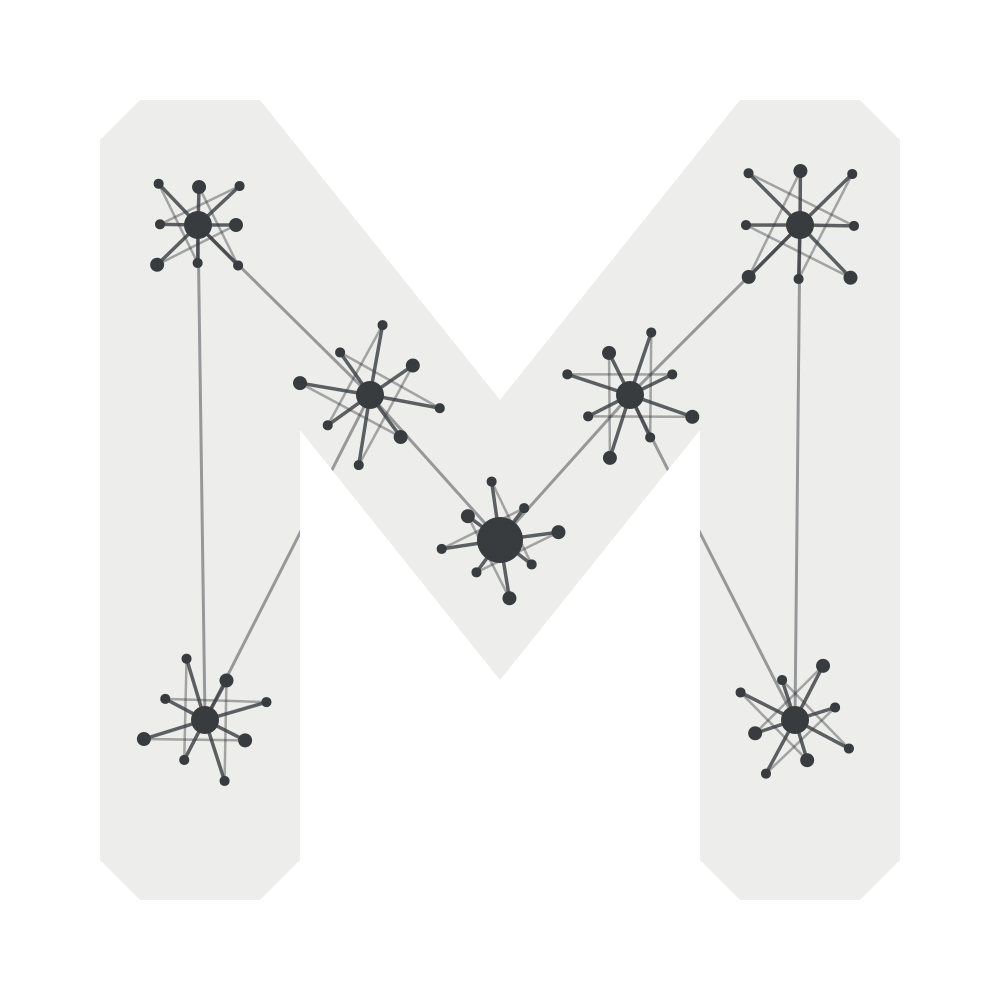
From stored information to an answer
- 01 · Retain
History + notes
Saved exchanges and selected decisions live outside the current context.
- 02 · Select
Retrieval
Bring relevant saved material into this turn. A useful item can be missed.
- 03 · Assemble
Current context
Instructions, recent messages and selected evidence are available together.
- 04 · Respond
Answer + review
Check the response against the evidence, not just its confidence.
Five jobs, not one feature
Context is material available for this turn. History records earlier exchanges. Durable notes preserve selected information. Retrieval selects what to bring back. Compaction shortens working material. Storage alone does not establish successful recall.
A detail that exists—but gets missed
Invented example, not a test result: someone plans a community-garden flyer. They choose Saturday and specify that the wording must not imply plants are free. A dated note records both decisions.
In a new session, the assistant is asked for a headline. If the note is retrieved, both constraints are available. If retrieval misses it, the history can remain stored while the headline misses a requirement. The diagnostic is: was the fact saved, selected, and used?
Now change the event to Sunday. Does the system distinguish the current decision from the older one? An evaluation needs corrections and dates, not just successful recall of unchanged facts.
What the sources establish
Context engineering
Anthropic's context-engineering article distinguishes compaction from structured notes persisted outside context and brought back later. It informs the vocabulary here; the example and visual arrangement are original.
Hermes
The Hermes memory guide documents bounded persistent notes and a separate mechanism for searching previous conversations. These are related capabilities, not interchangeable descriptions of one store.
Lossless Claw
The Lossless Claw README describes preserving raw messages, assembling summaries with recent messages, and retrieving original details. My interpretation: retained originals make recovery possible; they do not guarantee every response retrieves or uses the right detail.
Documentation rechecked. These are documented mechanisms, not local verification of performance.
A small test worth doing next
Use synthetic notes with known answers, a distractor, a changed decision and one question the notes cannot answer. Record the material supplied to the model and its response. Compare an ordinary session, a fresh session and a compacted handoff where supported.
Score correct answers, unsupported assertions, missed constraints and appropriate uncertainty separately. No memory-system experiment has been executed for this article; a reproducible MartyBytes companion is planned.
Download the evaluation checklist (.txt)